

Interest in GLP-related research has increased dramatically in recent years. For many people, awareness of these pathways begins not in a laboratory, but through well-known prescription drug brand names frequently discussed in the media. As a result, researchers and consumers alike often ask the same question:
Which research peptides correspond to the GLP pathways behind the brands I recognize?
This article explains what GLP peptides are, how GLP-1, “GLP-2,” and “GLP-3” are commonly used in research discussions, how those terms relate to familiar brand names, and why these pathways are widely studied — while clearly distinguishing research compounds from prescription drugs.
GLP stands for Glucagon-Like Peptide, a family of naturally occurring peptide hormones involved in metabolic and digestive signaling.
Scientifically, the two primary naturally occurring GLPs are:
GLP-1 (Glucagon-Like Peptide-1)
GLP-2 (Glucagon-Like Peptide-2)
They activate different receptors and influence different biological systems. However, in modern research conversations and supplier catalogs, the terms GLP-1, GLP-2, and GLP-3 are often used as informal shorthand to describe pathway complexity, not strict hormone definitions.
Understanding this distinction is critical.
GLP-1 and GLP-2 are naturally occurring hormones
They act on different receptors
They are not interchangeable
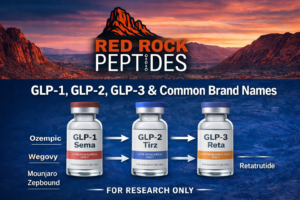
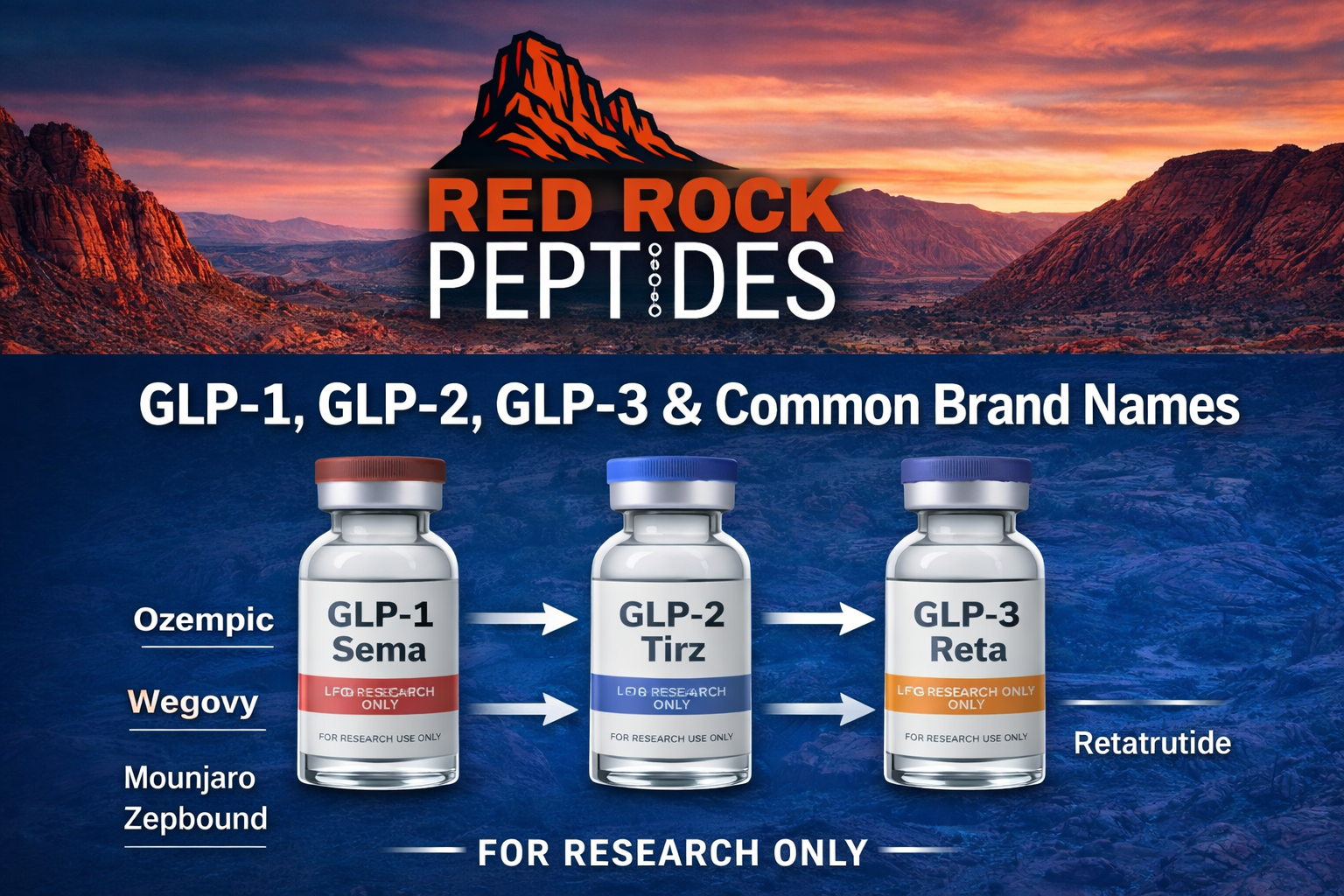
GLP-1 → single-pathway GLP-1 receptor activity
“GLP-2” → dual-pathway GLP research (GLP-1 + GIP)
“GLP-3” → triple-pathway GLP research (GLP-1 + GIP + glucagon)
This shorthand exists because it helps researchers quickly differentiate between single-, dual-, and triple-pathway metabolic research models, especially when those pathways are frequently discussed in relation to public drug brands.
Before looking at research peptides, it helps to understand why GLP-related drugs are commonly prescribed and widely discussed.
Drugs associated with GLP-1 receptor activity are commonly prescribed by healthcare providers for:
Type 2 diabetes management
Chronic weight management in qualifying patients
Blood glucose regulation
These drugs target the GLP-1 receptor, which plays a role in insulin signaling, glucose response, and appetite regulation. Their clinical use has brought widespread attention to GLP-1 pathways, driving increased scientific interest in how these receptors function.
Some newer prescription drugs interact with two metabolic pathways — GLP-1 and GIP. These medications are often prescribed for:
Type 2 diabetes
Metabolic dysfunction
Weight management under medical supervision
Because they activate multiple receptors, they have increased interest in dual-pathway metabolic signaling, both clinically and in research environments.
Emerging pharmaceutical research has explored drugs that interact with three metabolic pathways:
GLP-1 receptors
GIP receptors
Glucagon receptors
These compounds are often described publicly as next-generation metabolic treatments, further expanding interest in complex receptor interaction and signaling models.
It’s important to be clear: research peptides are not prescription drugs. They are not approved, not prescribed, and not intended for diagnosis or treatment.
However, in research settings, compounds are often discussed in relation to the same pathways that are highlighted by well-known brands. This has led to commonly understood research shorthand.
GLP-1 Sema is used in research contexts to study GLP-1 receptor signaling.
When people hear about widely discussed GLP-1 drug brands, they are hearing about medications designed to act on this same receptor pathway. In research environments, semaglutide-based compounds are studied to better understand receptor interaction, signaling behavior, and metabolic mechanisms — strictly in non-clinical, controlled research settings.
Common understanding:
Brand awareness → GLP-1 pathway
Research context → GLP-1 Sema
Scientifically, GLP-2 is a different hormone. However, in research shorthand, the term “GLP-2” is commonly used to describe dual-pathway GLP research compounds.
Under this informal but widespread convention:
GLP-2 Tirz refers to tirzepatide-based research
These compounds are studied for interaction with GLP-1 and GIP receptors
The shorthand helps distinguish dual-pathway research from single-pathway GLP-1 research
When people hear brand names associated with dual-pathway metabolic drugs, they are usually referencing this combined receptor activity — which is why “GLP-2 Tirz” has become common language in research catalogs.
GLP-3 is not a formally defined biological hormone. In research discussions, it is commonly used to describe triple-pathway GLP research compounds.
GLP-3 Reta refers to retatrutide-based research, which is studied for interaction with:
GLP-1 receptors
GIP receptors
Glucagon receptors
As public discussion around next-generation metabolic drugs grows, this shorthand helps researchers quickly identify triple-pathway signaling models.
| Research Shorthand | Research Peptide | Pathways Studied | Public Drug Context |
|---|---|---|---|
| GLP-1 | GLP-1 Sema | GLP-1 receptor | Drugs prescribed for diabetes & weight management |
| “GLP-2” | GLP-2 Tirz | GLP-1 + GIP receptors | Dual-pathway metabolic drugs |
| “GLP-3” | GLP-3 Reta | GLP-1 + GIP + glucagon receptors | Emerging triple-pathway drugs |
Note: These labels reflect research shorthand, not pharmaceutical equivalence or biological hormone definitions.
Researchers across Southern Utah — including St. George, Washington, Hurricane, Ivins, Santa Clara, and nearby communities — often encounter GLP terminology through public drug conversations before exploring the underlying science.
Clear education helps bridge that gap, allowing researchers to:
Understand which pathways are being studied
Avoid confusion between drugs and research compounds
Make informed decisions when sourcing research materials
Local access can also reduce shipping delays, support tighter research timelines, and improve consistency for ongoing projects.
Red Rock Peptides carries:
GLP-1 Sema
GLP-2 Tirz
GLP-3 Reta
All compounds are clearly labeled for research use only and are intended exclusively for laboratory study, pathway exploration, and non-clinical research. We serve researchers throughout St. George and Washington County, with same-day local delivery available when orders are placed before cutoff times, along with nationwide shipping.
GLP-1, GLP-2, and GLP-3 are often used differently in research discussions than in formal biology. By understanding how these terms function as research shorthand, researchers can better connect the brand names they hear about with the actual pathways being studied, without confusing research compounds with regulated prescription drugs.
Clarity, transparency, and responsible sourcing are essential as interest in GLP-related research continues to grow.