
BPC-157, TB-500, and similar peptides are everywhere online. They’re discussed in fitness circles, promoted in recovery forums, and even mentioned by some clinics as part of so-called “peptide therapy.”
But here’s the reality most people never hear clearly:
There is no FDA-recognized prescription pathway for BPC-157, TB-500, or most non-FDA-approved peptides.
And because of that, the way these compounds are commonly discussed, suggested, or administered creates serious legal and regulatory confusion.
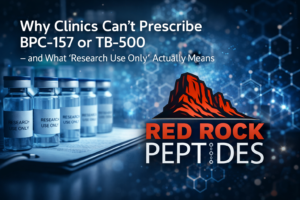
This article explains — plainly and accurately — why clinics cannot lawfully prescribe these peptides for routine patient care, what “research use only” actually means, and why legitimate research distribution is currently the only compliant framework that exists.
U.S. medical practice is built around a clear distinction:
FDA-approved drugs may be prescribed by licensed providers
Approved drugs may be used off-label
Unapproved drugs do not qualify for either
This is where many peptide claims fall apart.
They are not:
Approved prescription medications
Approved compounded drugs
Dietary supplements
Because they are unapproved, they do not have:
An FDA-approved indication
An FDA-recognized dosing standard
A lawful prescription pathway for routine treatment
This matters because “off-label” prescribing does not apply to unapproved substances. Off-label use only exists after FDA approval.
When a clinic claims to prescribe, inject, or sell BPC-157 or TB-500 for human use, it is operating outside the normal medical framework.
Here’s why.
Without FDA approval or an authorized investigational pathway, licensed providers do not have authority to prescribe experimental compounds as treatment.
That means:
No lawful prescription
No recognized standard of care
No protection under traditional medical use
Compounding pharmacies are limited in what bulk drug substances they may use. Certain peptides — including BPC-157 — have been identified by regulators as posing significant safety concerns in the compounding context.
Compounding rules do not convert an unapproved drug into a lawful prescription medication.
Calling something:
“regenerative”
“recovery-focused”
“wellness-based”
does not change whether a substance is approved or lawful to administer.
Regulators look at intended use and conduct, not branding.
“Research use only” (RUO) is one of the most misunderstood labels in the peptide space.
The compound is supplied for laboratory or investigational research
The supplier does not claim medical or therapeutic benefit
No dosing, protocols, or administration instructions are provided
The product is not marketed to patients
In other words:
RUO is a research supply model, not a treatment model.
It is not permission for human use
It is not a workaround for clinics
It is not a loophole for personal injection
It does not authorize medical recommendations
RUO exists to allow scientific research to occur before FDA approval — not to bypass it.
This is where clarity matters.
If someone is using BPC-157, TB-500, or similar peptides for human treatment outside of a properly authorized clinical trial, there is no FDA-recognized lawful prescription pathway for that use.
That does not automatically mean:
The individual is being prosecuted
Enforcement is immediate
But it does mean:
The supply chain is not FDA-approved for human use
The intended use is not recognized under U.S. drug law
The situation exists outside standard compliance frameworks
This is why the market feels “gray” — not because the rules are unclear, but because they’re often ignored or misunderstood.
Clinics don’t just answer to federal regulators — they answer to state licensing boards.
Even when enforcement seems inconsistent:
Professional discipline is still possible
Licenses can still be challenged
Liability does not disappear because something is popular
This is why many clinics:
Avoid written prescriptions
Avoid dispensing directly
Use vague educational language
Distance themselves from sourcing
Those behaviors are signals of regulatory uncertainty — not proof of legality.
Yes — when properly defined.
At present:
There is no FDA approval
There is no standard prescription pathway
There is no approved supplement classification
There is no lawful retail medical distribution model
The only compliant framework that exists today is legitimate research distribution, meaning:
Supplied for scientific investigation
Not sold as treatment
Not administered to patients
Not marketed for healing or recovery
Anything else blurs into non-compliance.
Possibly — but only through formal channels.
For peptides like BPC-157 or compounds related to TB-500 to become lawful prescription options, they would need:
Controlled clinical trials
Demonstrated safety and efficacy
FDA approval
Regulated manufacturing standards
Until then, claims that these peptides are “prescribable” or “approved” are premature.
There is a reason the peptide space feels confusing:
marketing has moved faster than regulation.
The reality is simpler than the hype:
BPC-157 and TB-500 are not FDA-approved drugs
Clinics generally cannot lawfully prescribe or administer them for routine patient care
“Research use only” is not a loophole
Research distribution is currently the only compliant framework
Understanding this protects researchers, providers, and consumers — and keeps legitimate science separate from risky shortcuts.